



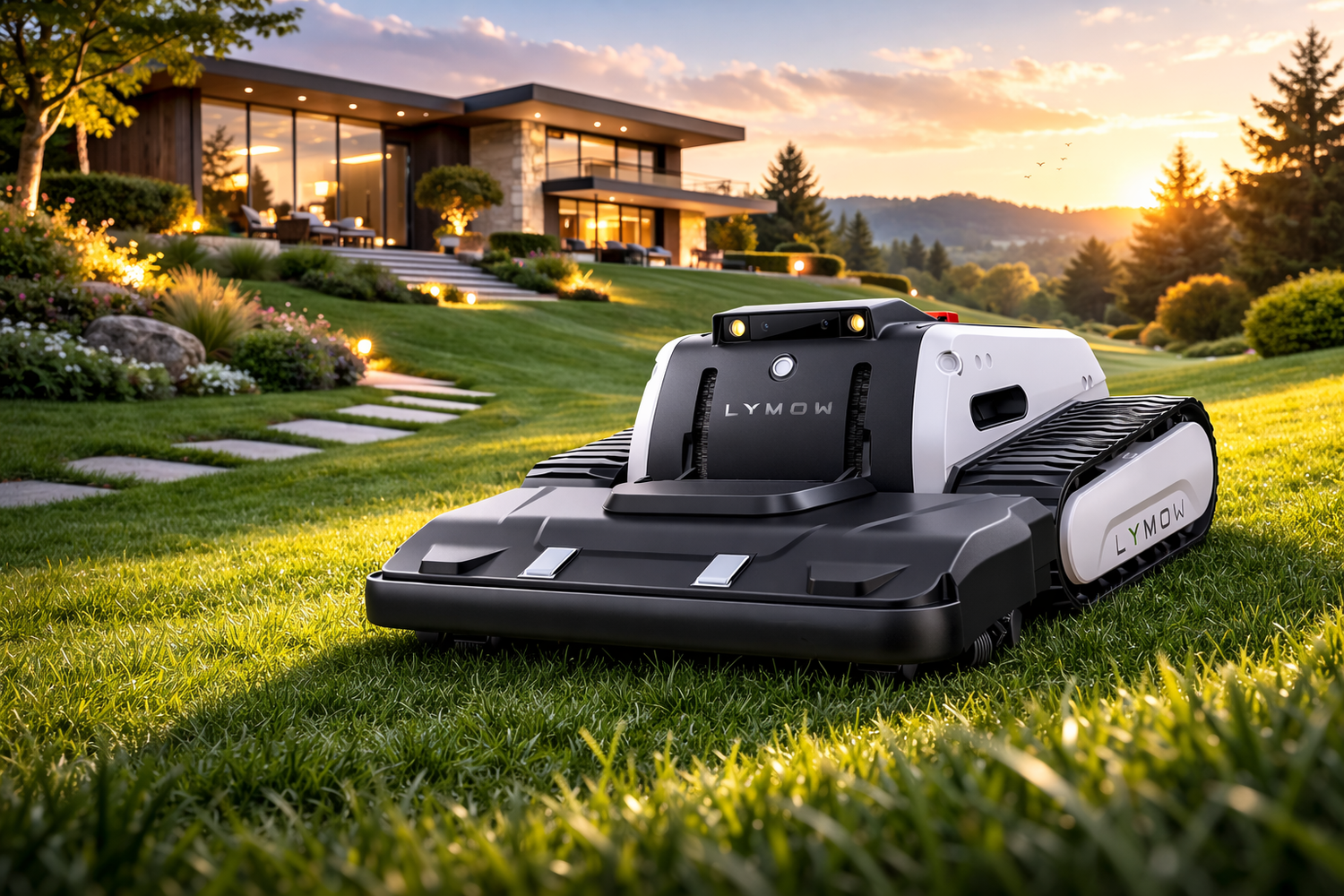
The robotic lawn mower market in 2026 spans from entry-level budget machines to premium models, which can make the right choice feel unclear. The core decision hinges on three factors: lawn size, terrain complexity, and navigation technology.
Budget mowers usually rely on physical boundary wires and suit simple, flat yards up to about 0.5 acres. Premium models like the Lymow One Plus (MSRP $2,999) eliminate wires entirely through RTK+VSLAM navigation, handle extreme 45° slopes with heavy-duty tracks, and effortlessly manage complex properties.
If you have a suburban lawn between 0.5 and 1 acre—or a sprawling estate—upgrading to a wire-free premium system delivers a massive jump in convenience, durability, and flexibility over basic models.
Understanding the Price Tiers: What You Actually Get
Budget Models ($700-$1,500): Wire-Based Basics for Simple Yards
Entry-level robotic mowers serve flat lawns under 0.5 acres effectively. However, they typically require several hours (or days) of manual perimeter wire installation. Slope capability is severely limited, cutting widths are narrow, and single-zone operation restricts flexibility. The value proposition works best only for straightforward, rectangular lawns without obstacles, hills, or multiple zones.
Premium Models ($2,000-$6,000): Wire-Free Intelligence for Complex Terrain
Premium robotic mowers change the experience through satellite and visual navigation systems that eliminate boundary wires. The Lymow One Plus exemplifies this tier at an MSRP of $2,999. It features RTK+VSLAM fusion technology, Explore RTK-VSLAM Technology, AI obstacle detection, and a massive 16-inch cutting width. Crucially, its Heavy-Duty Track Drive System easily conquers steep 100% (45°) slopes where wheeled competitors slide and fail. Premium models in this category also offer multi-zone management, smartphone app control, and robust IPX6 weather resistance.
The $1,500-$2,000 Decision Point
The gap between budget and premium represents more than just added features; it is about operational freedom. Wire-free setup takes minutes instead of a half-day of hard labor. Premium systems navigate around driveways, sidewalks, and garden beds dynamically. Battery technology is also vastly superior, ensuring your mower doesn't need to be replaced after a few seasons.
Key Decision Factors: Matching Mower to Lawn Reality
- Lawn Size: Small properties under 0.25 acres suit budget wire-based models adequately. However, medium-to-large lawns demand more. The Lymow One Plus boasts a massive coverage rate of 1.73 acres per day and can manage properties up to 12 acres, completely outclassing budget limitations.
- Terrain Complexity: Slope capability defines real-world performance. Budget mowers struggle on inclines. Mid-range wheeled AWD systems do slightly better, but Lymow’s continuous track design delivers confident traction on 45° grades and easily crosses 2.8-inch obstacles (like tree roots and pavers).
- Navigation Technology: Boundary wire systems lock you into fixed perimeters. If you plant a new tree, you have to dig up the wire. Conversely, the Lymow One Plus uses RTK+VSLAM to map up to 15 acres and manage 80 customizable zones. If the GPS signal drops under a heavy tree canopy, the VSLAM visual cameras take over, allowing the mower to continue seamlessly for up to 10 minutes without RTK.
- Battery Performance: Budget models use standard lithium-ion batteries that degrade quickly. The Lymow One Plus utilizes a 15,000 mAh LiFePO₄ battery rated for an incredible 2,000 charge cycles, delivering stable, multi-year reliability.
Top Models by Category: 2026 Expert Picks
Lymow One Plus: Premium Performance at Mid-Premium Pricing
The Lymow One Plus delivers flagship-level specifications at an MSRP of $2,999.
- Navigation: RTK+VSLAM ensures reliable operation under heavy tree cover where pure GPS systems fail.
- Obstacle Avoidance: An array of Binocular AI Vision, 5 Ultrasonic Sensors, and 2 Hall Bumper Sensors identifies common objects like furniture, toys, and pets.
- Cutting Power: The Lycut System 2.0 features dual rotary blades made from SK5 tool steel (50 HRC hardness) driven by a 1,785 W peak-power motor.
- Durability: Built with an A380 Automotive-Grade Frame and IPX6 waterproofing.
Total Cost of Ownership: Five-Year Reality Check
Budget mowers may look more affordable at the register, but they come with hidden costs: wire installation time, wire-break repairs, and faster battery degradation.
A premium wire-free model like the Lymow One Plus removes boundary wire setup entirely and features a 2,000-cycle battery. When you factor in the elimination of wire-related upkeep and the sheer longevity of the machine, the premium investment pays dividends year after year.
Making Your Decision
- Choose a Budget Wire-Based Mower if: Your lawn is flat, perfectly simple, under 0.5 acres, and you are willing to spend a weekend burying perimeter wire and maintaining it.
- Choose a Premium Wire-Free System if: Your property exceeds 0.5 acres, includes meaningful slopes, features multiple zones, or contains obstacles. At an MSRP of $2,999, the Lymow One Plus delivers a fundamentally different ownership experience: faster setup, extreme slope capability, and hands-free perfection.
Frequently Asked Questions
Q: What’s the best robotic mower for a 0.75+ acre lawn with 25-30° slopes in 2026?
A: Prioritize wire-free RTK navigation and track traction. The Lymow One Plus handles medium to massive properties and effortlessly climbs slopes up to 45° (100% incline) using its Heavy-Duty Track Drive System.
A: Prioritize wire-free RTK navigation and track traction. The Lymow One Plus handles medium to massive properties and effortlessly climbs slopes up to 45° (100% incline) using its Heavy-Duty Track Drive System.
Q: Are wire-free robotic mowers worth the extra $1,500-$2,000 cost?
A: Yes, for medium-to-large or more complex properties. Wire-free models remove installation labor, reduce ongoing wire maintenance, and make zone editing far easier through an app.
A: Yes, for medium-to-large or more complex properties. Wire-free models remove installation labor, reduce ongoing wire maintenance, and make zone editing far easier through an app.
Q: How long do robotic mower batteries actually last?
A: Budget lithium-ion batteries wear down fast. The premium LiFePO₄ battery in the Lymow One Plus is rated for 2,000 charge cycles, offering years of stable performance far outlasting standard competitors.
A: Budget lithium-ion batteries wear down fast. The premium LiFePO₄ battery in the Lymow One Plus is rated for 2,000 charge cycles, offering years of stable performance far outlasting standard competitors.
Q: Can robotic mowers handle thick, overgrown grass?
A: Budget mowers with 300–500W motors bog down and stall in thick growth. The Lymow One Plus generates an incredible 1,785 W peak power, driving SK5 tool steel dual rotary blades. This ensures stable blade speed through dense, overgrown grass, delivering a clean cut every time (adjustable from 1.2 to 4.0 inches).
A: Budget mowers with 300–500W motors bog down and stall in thick growth. The Lymow One Plus generates an incredible 1,785 W peak power, driving SK5 tool steel dual rotary blades. This ensures stable blade speed through dense, overgrown grass, delivering a clean cut every time (adjustable from 1.2 to 4.0 inches).
Transform Your Lawn Care with Smart Technology
Choosing between budget and premium robotic mowers depends on matching capabilities to your property’s demands. Lymow One Plus combines RTK+VSLAM navigation, 45° slope capability, unstoppable cutting power, and premium longevity at an MSRP of $2,999.
Ready to eliminate weekly mowing while achieving professional lawn results?
Explore the future of automated lawn care at Lymow.
Ready to eliminate weekly mowing while achieving professional lawn results?
Explore the future of automated lawn care at Lymow.


Leave a comment
This site is protected by hCaptcha and the hCaptcha Privacy Policy and Terms of Service apply.